
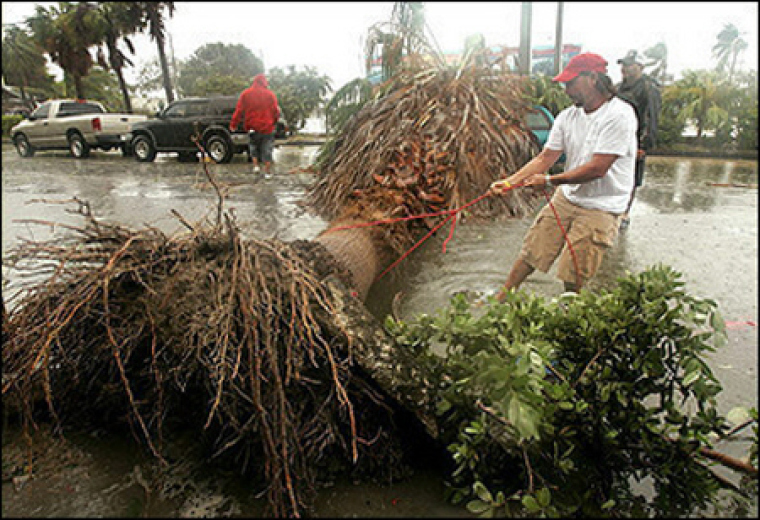
Hurricane Dennis strengthened to a Category 4 storm as it drew closer the Gulf Coast. Nearly 1.4 million people are under evacuation orders.
The hardest hit areas are expected to stretch from the eastern end of Louisiana to the Panhandle of Florida as of Sunday morning, according to the National Hurricane Center. Many towns in the area are almost deserted, according to the Associated Press.
The Salvation Army has announced 15 mobile feeding units will gather in Tallahassee, Sunday by 5 p.m. to prepare for disaster relief efforts.
The storm, which had weakened to Category 2 over Cuba late last week, strengthened as it passed through the Gulf area, reaching sustained windspeeds of 145mph.
Max Mayfield, director of the National Hurricane Center in Miami says that Category 4 storms are "not just a little bit worse - it's much worse," according to AP
"Damage increases exponentially as the windspeed increases. And no matter where it makes actual landfall, it's going to have a tremendous impact," he added.
The storm has already been blamed for at least 20 deaths in Haiti and Cuba. Yesterday, the storm knocked out power and flooded streets in the Florida Keys as it passed to the right of the islands.
Around 700,000 people are under orders to evacuate in Florida, 500,000 in Alabama and 190,000 in Mississippi. Interstate 65 in Montgomery, Alabama has been turned into a one-way route, according to AP.
Police have gone through many areas announcing the evacuation orders.
Several relief teams from Christian organizations have been preparing for relief efforts throughout the Southeast, inlcluding the Salvation Army, North American Mission Board, and Convoy of Hope.
Salvation Army relief teams and mobile feeding units will converge in Tallahasse, Florida in preparation for the aftermath. The units will converge at the Sam's Club warehouse located at 3221 N. Monroe Street in Tallahassee, just off I-10 on Sunday, June 10 by 5:00 pm, according to a news release Saturday evening.
This will enable the units to help once the storm has passed. Each of the 15 mobile feeding units will be stocked to serve 1,500 hot meals to victims and relief workers on the scene.
"It's a matter of safety at this point," said Kevin Smith, disaster services director for the Salvation Army in Florida.
"We need to be far enough to be out of harms way, but close enough to respond quickly once its clear to enter the area and begin to set up our operations," he added.
There are 43 mobile feeding units and other suport vehicles that will respond. As of last night, 6 were being used in South Florida and the rest will be on their way to be used for reinforcement relief efforts in the next few days.
Last year, nearly 30,000 meals were being served by the Salvation Army at peak hurricane-relief operation. This year, more than 200 mobile feeding units will be available throughout the southeastern U.S., ready to respond immediately.
On Friday, the NAMB said it would be sending personnel to provide assistance at The Salvation Army and American Red Cross command centers in Alabama, Texas, And Washington D.C.
Also, Missouri-based Convoy of Hope announced it would be sending truckloads of water and ice to the areas expected to be hit most heavily by the storm.
Financial donations to assist with relief efforts by The Salvation Army can be made by calling 1-800-SAL-ARMY, or online at www.salvationarmy.org, or through mail by check at The Salvation Army Disaster Relief, P.O Box 270848 Tampa, FL 33624.
For online donations to the NAMB Disaster Relief fund, visit www.namb.net/dr.
For online donations to Convoy of Hope relief efforts, go to www.convoyofhope.org.
Francis Helguero
Christian Today Correspondant